Every quantum chip has its own noise. We measure it from the chip's own syndromes.
Syndromics turns the error-correction signals a processor already produces into a physical model of its real, current noise. Decoders get better weights, and engineers see which gate, qubit or measurement has drifted.
ibm_kingston: published calibration vs Syndromics model, on held-out shotsDecoders are only as good as the noise model they are given.
A quantum error-correction decoder has to guess which errors happened. To guess well it needs to know how likely each error is. Today that usually comes from the published calibration: measured hours or days earlier, with different circuits, and averaged.
Noise drifts
Qubits and couplers change between calibrations. A gate that was fine yesterday can be several times worse today.
Calibration measures something else
Published readout error is measured at the end of a circuit. Error correction measures and resets qubits mid-circuit, every round, and that is often much worse.
Every chip is different
Each processor, and each region of it, has its own pattern of errors. One average model fits none of them exactly.
On IBM's ibm_kingston, the measured model halved logical errors.
We ran a distance-5 repetition code (9 qubits, 10 rounds, 30,000 shots) through IBM's free Open Plan. Each noise model was fitted on half the shots and tested on the other half, which it never saw. Six different splits; the same PyMatching decoder every time.
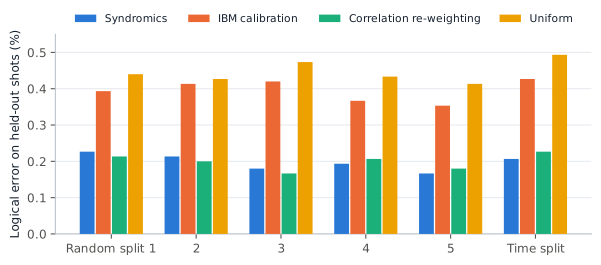
dbukcjvf8rhs73bmf9l0.| Noise model given to the decoder | Logical error |
|---|---|
| No decoding | 2.22% |
| Uniform (no device data) | 0.447% |
| IBM published calibration | 0.396% |
| Standard correlation re-weighting | 0.199% |
| Syndromics | 0.198% |
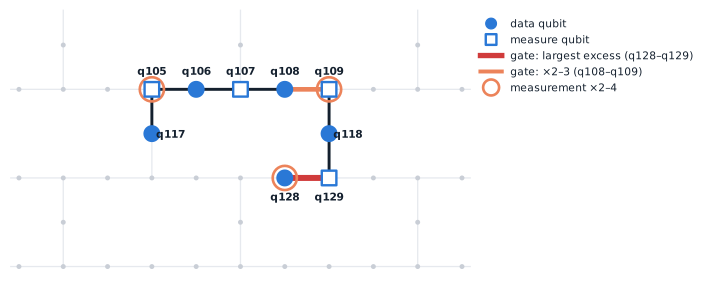
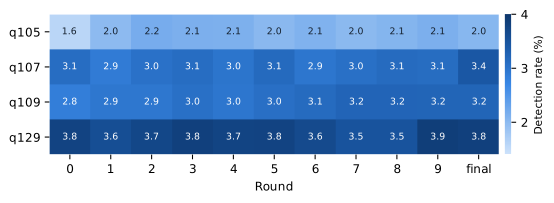
From syndromes to a physical noise model in seconds.
Run a short code
One job: a small error-correction circuit plus a few reference circuits on the qubits you care about. Minutes of QPU time.
Fit the components
Starting from the calibration, Syndromics fits one factor per measurement, idle and two-qubit gate, so the model reproduces the measured detection rates and correlations. It moves a component only when the data clearly disagree.
Use the model
Hand the corrected model to any decoder, flag the components that have drifted, and steer circuits away from them with noise-aware qubit placement.
Every number above reproduces on your laptop.
The demo kit includes the raw shots from our ibm_kingston job. Reproducing the result needs no IBM account and no QPU time. With an IBM Quantum account, the same kit runs the experiment on any Heron backend, on a line it chooses.
- Technical note: the experiment, method, results and limits (6 pages).
- Source code on GitHub (MIT licence), including the raw shots and a test that reproduces the result.
# Python 3.10–3.13
git clone https://github.com/wishapples/syndromics.git
cd syndromics
pip install -e ".[ibm,dev]"

# reproduce our ibm_kingston result (seconds, no QPU)
pytest tests/test_decodecheck_real.py -q

# run it on your own IBM backend
syndromics-ibm-demo check
syndromics-ibm-demo validate --backend ibm_kingston --yes
From one run to a repeatable record.
First hardware run
ibm_kingston: logical error halved vs calibration; fault localised.
Transfer test
Fit on one circuit, decode a different one on the same qubits: the test the standard method cannot pass.
Across lines and days
Does the gain repeat? A chip-wide health check of what has drifted since calibration.
Surface and qLDPC codes
Codes that see both error types; measured priors for belief-propagation decoders.